

Differential Reinforcement in ABA: 5 Types, Examples & How to Track Data
Differential reinforcement in ABA explained: five types, real examples, how to choose the right one, and how to track data.

- Stimulus Discrimination Training in ABA: Examples & How to Track Data - October 13, 2026
- Skills Assessment in ABA: A BCBA’s Guide to Tools & Goal Setting - October 12, 2026
- Differential Reinforcement in ABA: 5 Types, Examples & How to Track Data - October 9, 2026
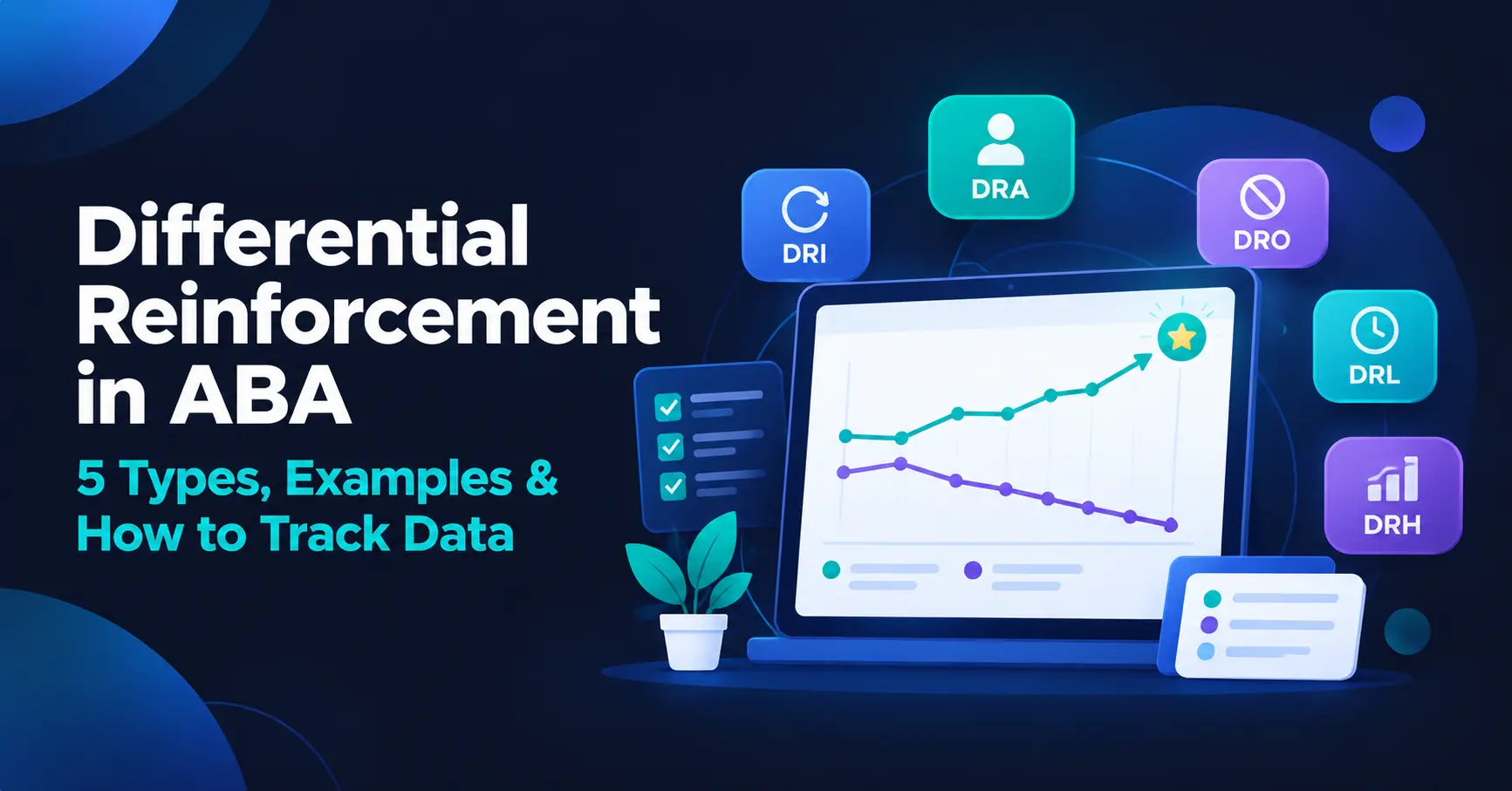
Differential reinforcement in ABA is one of the first tools a BCBA reaches for when a behavior needs to go down and a better one needs to come up. The idea is simple: reinforce some responses, withhold reinforcement for others, and let the contrast teach. The details are where plans tend to fall apart. This guide covers the five main types with examples you can picture in a real session, how to choose between them, and what data to collect.
What Is Differential Reinforcement in ABA?
Differential reinforcement means reinforcing a response under certain conditions while withholding reinforcement under others. In behavior reduction, the problem behavior stops paying off and something else starts paying off instead. It’s a less intrusive option than punishment-based procedures, and it’s easier to explain to families and school teams, since they can see what the learner is being taught to do.
Most DR procedures pair a reinforcement contingency with extinction for the problem behavior. Skip the second part and the plan quietly stops working. Whichever type you pick, the reinforcer should also match what the FBA says the behavior is getting the learner.
The 5 Types of Differential Reinforcement
DRA (Differential Reinforcement of Alternative Behavior)
In DRA, you reinforce an appropriate alternative behavior and withhold reinforcement for the problem behavior. The alternative doesn’t have to resemble the problem behavior at all. It just has to be something you’d rather see. When it serves the same function, as in functional communication training, DRA teaches the learner a better way to get what they want.
It works best when you know the function and can teach a replacement skill. It’s a weaker choice when the learner can’t yet perform the alternative, or when the problem behavior is dangerous and you can’t safely withhold reinforcement.
Example: A 4-year-old in a clinic program grabs toys from peers. His RBT teaches him to hand over a “my turn” card. Each time he does, he gets the toy within a few seconds, with the peer prompted to share. Grabbing is blocked and earns nothing. The first week is mostly prompted. By week three the prompts are fading and the card comes out on its own.
DRI (Differential Reinforcement of Incompatible Behavior)
DRI reinforces a behavior that can’t happen at the same time as the problem behavior. If the learner is doing one, they physically can’t be doing the other. That removes the gray area about whether the alternative is occurring.
It works when the problem behavior has an obvious physical opposite, like being seated versus out of seat, or hands in lap versus hitting. It’s a poor fit when no truly incompatible behavior exists, which is more often than people expect.
Example: An 8-year-old in a general education classroom leaves her seat repeatedly during independent work. She earns a token at the end of each 5-minute block spent fully seated, and four tokens buy a few minutes with a favorite book. When she leaves her seat, the teacher gives no attention and quietly redirects her.
DRO (Differential Reinforcement of Other Behavior)
DRO delivers reinforcement when the problem behavior hasn’t occurred for a set period. It doesn’t care what the learner does instead, only that the target behavior stays away. In whole-interval DRO, the behavior must be absent for the entire interval. In momentary DRO, it only has to be absent when the interval ends.
DRO fits when behavior needs to come down quickly and there’s no obvious alternative, or as a bridge while you teach a replacement skill. Its weakness is that it teaches nothing. A learner can earn reinforcement while doing some other problem behavior, so keep an eye out for that.
Example: A 5-year-old screams at the dinner table at home. Baseline shows it happening roughly every four minutes. The BCBA sets the starting interval at two minutes, shorter than the typical gap, so success is possible right away. Each screaming-free interval earns a sticker and praise from a parent. If he screams, the timer resets. Over several weeks the interval stretches to three minutes, then five.
DRL (Differential Reinforcement of Low Rates)
DRL reinforces a behavior when it occurs at or below a set rate. Unlike the others here, the goal is reduction, not elimination. Variations include full-session DRL (stay under a limit for the session), interval DRL, and spaced-responding DRL (a minimum time must pass between responses).
Use it for behaviors that are fine in moderation and a problem in excess, like calling out answers or asking for help over and over. Don’t use it for anything dangerous or anything that shouldn’t happen at all. Set the first limit near baseline, because a limit far below it sets the learner up to miss reinforcement again and again.
Example: A 9-year-old in a clinic-based school program asks “Is this right?” about 20 times in a 30-minute work block, and it’s breaking up his work. The team sets the first limit at 15. Staying at 15 or under earns a point, and points trade for a short game at the end of the session. Every few sessions the limit drops.
DRH (Differential Reinforcement of High Rates)
DRH is the odd one out. It reinforces a behavior when it occurs at or above a criterion rate, so it’s used to increase a behavior, not decrease one. The behavior needs to already be in the learner’s repertoire. If it isn’t, you’re looking at prompting or shaping first.
Use it when you want more of a good thing, like peer initiations, on-task responses, or answering questions.
Example: A 6-year-old in a social skills group greets or invites a peer to play once, maybe twice, per session. The criterion is three initiations in a 20-minute group. When she reaches it, she picks the closing activity. After several sessions at criterion, the team raises it to four.
Differential Reinforcement Types Compared
| Type | Reinforcement delivered when | Best used for | Example |
|---|---|---|---|
| DRA | An appropriate alternative behavior occurs | Teaching a replacement skill | Handing over a “my turn” card instead of grabbing |
| DRI | A behavior that can’t occur with the problem behavior occurs | Problem behaviors with a clear physical opposite | Staying seated instead of leaving the seat |
| DRO | The problem behavior is absent for a set interval | Fast reduction when no alternative is obvious | No screaming for 2 minutes |
| DRL | The behavior occurs at or below a set rate | Behaviors that are fine in moderation | 15 or fewer help requests in 30 minutes |
| DRH | The behavior occurs at or above a set rate | Increasing a behavior already in the repertoire | 3 or more peer initiations in 20 minutes |
How to Choose the Right DR Procedure
Start with the function from the FBA, then work through these questions in order:
- Is the behavior dangerous, or does it need to stop completely? Lean toward DRA or DRO, with a safety plan in place. DRL is off the table.
- Can the learner do a replacement behavior that serves the same function? If yes, DRA is usually your best bet.
- Is there a behavior that physically can’t happen alongside the problem behavior? That’s your DRI candidate.
- Is the behavior acceptable in smaller amounts? Consider DRL.
- Do you need more of a behavior the learner already has? That’s DRH.
In practice, DRA is the default for good reason, since it builds a skill. DRO often works best as a short-term bridge. Plans that combine procedures are common, such as DRA with a brief DRO to bring the rate down while the new skill takes hold.
Common Mistakes When Implementing Differential Reinforcement
Reinforcing the problem behavior by accident. This usually happens at the worst moment. A parent holds the line through nine screams and gives in on the tenth. That teaches the learner to scream ten times.
Starting with intervals or limits that are too hard. If a DRO interval is longer than the learner’s typical gap between behaviors, they’ll rarely earn anything. Early success matters.
Thinning too fast. Stretching an interval or tightening a limit after one good session is tempting. Wait for stable data first.
Delaying reinforcement. The longer the gap between the target response and the reinforcer, the weaker the contingency.
Skipping the preference assessment. A reinforcer that worked last month may be stale now. Check again.
Letting integrity slip. The plan only works as well as the least consistent person running it. Caregivers and school staff often need a short, written version and a quick check-in after the first week.
Reinforcing something worse in a DRO. Because DRO rewards “anything but,” watch what the learner does right before the interval ends.
How to Track Differential Reinforcement Data
Good DR data answers two questions: is the target behavior changing, and is the plan being run as written? Record these:
- The problem behavior, as frequency or rate, plus duration or latency when they matter
- The alternative or incompatible behavior, for DRA, DRI, and DRH
- Interval outcomes for DRO (met or not met), and the limit versus the actual count for DRL
- Reinforcement delivered, including how often and how quickly after the response
- Context, such as setting, staff, and what happened just before, so patterns show up
- Treatment integrity, meaning whether the procedure was run as written
Graph it with clear phase-change lines, and review it on a regular schedule. The graph is what tells you when to thin the schedule, change the criterion, or rethink the function.
Paper data sheets work for a small caseload. They get hard to manage when several RBTs run the same plan across sessions, and a supervisor ends up reconciling sheets before a team meeting. With ABA data collection software, RBTs can enter data during the session on mobile or web, and BCBAs can see real-time analytics and customizable graphs between supervision visits instead of after the fact. MeasurePM’s clinical reporting and graphing tools turn that data into progress reports without rebuilding charts by hand.
FAQ
What is the difference between DRA and DRO?
DRA reinforces a specific alternative behavior, so the learner is being taught what to do. DRO reinforces the absence of the problem behavior for a set interval, regardless of what the learner does instead. DRA builds a skill. DRO mainly lowers the behavior, which is why it’s often used briefly or alongside DRA.
Is DRI better than DRA?
Neither is better across the board. DRI works when a clear behavior can’t happen alongside the problem behavior, like staying seated instead of leaving the seat. DRA is more flexible, since the alternative can be any appropriate behavior. Many problem behaviors have no truly incompatible response, so DRA gets used more often.
When should DRL be used?
Use DRL for behaviors that are acceptable in moderation but become a problem at high rates, like calling out answers or asking for help repeatedly. Set the first limit close to the baseline rate, then lower it gradually. Avoid DRL for dangerous behavior or anything that shouldn’t happen at all. DRA or DRO fits those better.
Does differential reinforcement require extinction?
For DRA, DRI, and DRO, extinction (withholding reinforcement for the problem behavior) is usually part of the plan, because otherwise the problem behavior keeps paying off. It isn’t always possible, though. If the behavior is dangerous, the team needs a safety plan first. DRL and DRH work differently, since they adjust reinforcement around rate.
Putting It Into Practice
Differential reinforcement works when the plan is specific, the reinforcer matters to the learner, and everyone runs it the same way. Data is what shows whether that’s happening. If your team still reconciles paper sheets before supervision meetings, it may be worth seeing what session data tracking looks like in MeasurePM. You’ll find more guides in the MeasurePM resource center.
