

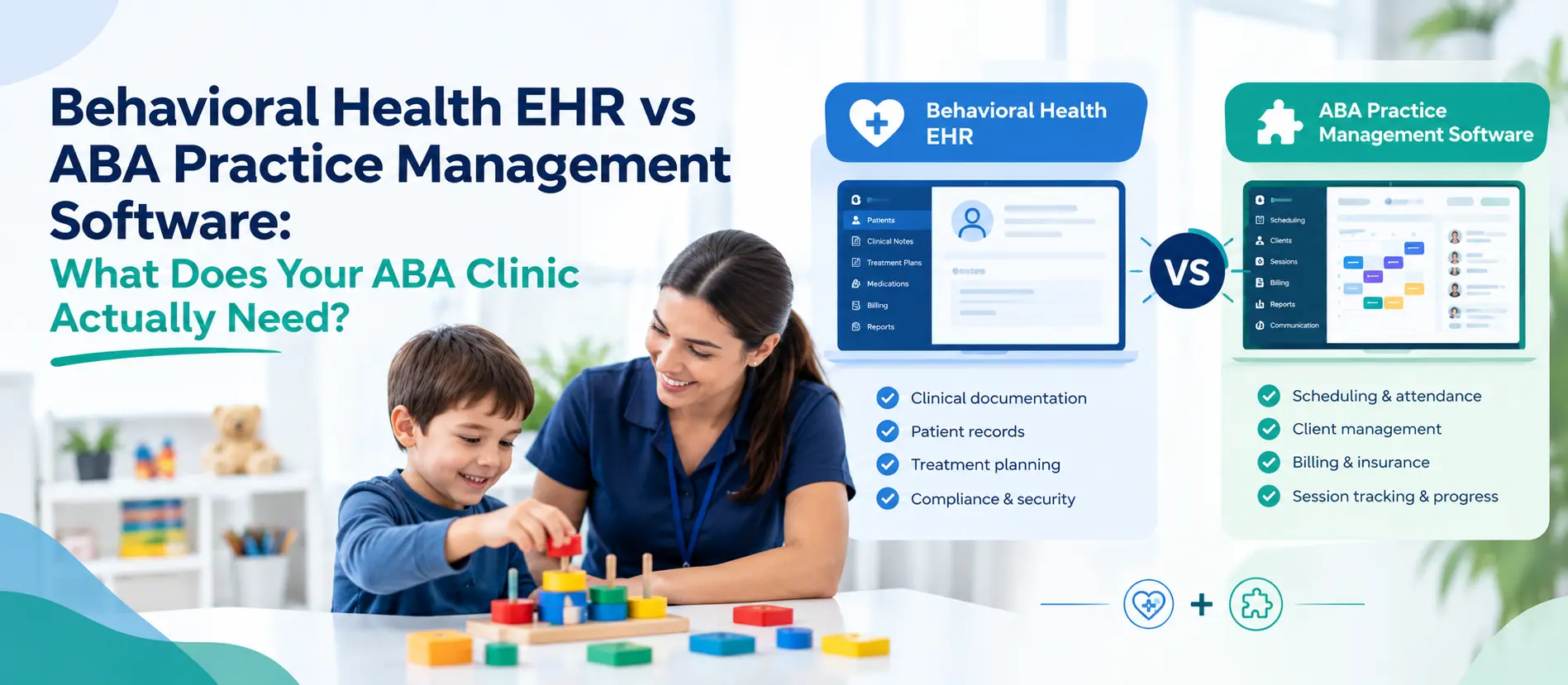
Behavioral Health EHR vs ABA Practice Management Software: What Does Your ABA Clinic Actually Need?
Learn how to choose the best ABA data collection app with essential features, real-time tracking, reporting, mobile access, and security.

- ABA Practice Management System: What It Is & Features Every Clinic Needs - November 5, 2026
- ABA Therapy Practice Management: Scheduling, Billing, Authorizations & Staffing - November 4, 2026
- Behavioral Health EHR vs ABA Practice Management Software: What Does Your ABA Clinic Actually Need? - October 30, 2026
Picture this. You are shopping for software to run your ABA clinic. A vendor walks you through a clean demo of a Behavioral Health EHR. Client records, progress notes, e-signatures, billing. Everything looks tidy. Then your clinical director asks a simple question: where do the RBTs enter session data?
The room gets quiet.
That one question is why so many ABA owners end up with the wrong tool. A behavioral health EHR and ABA practice management software sound alike, but they were built for different jobs. One is designed around a therapist’s office. The other is designed around how ABA actually runs day to day, with technicians, supervisors, authorizations, and a lot of data.
This guide explains what each type of software does, where they overlap, and how to figure out what your clinic needs. No jargon, and no pressure to buy anything. Just a clear way to think it through.
The short answer
Most ABA clinics need software built around ABA workflows first. A general behavioral health EHR can hold records and notes, but it often struggles with session data, program graphs, and unit-based authorizations. If your clinic also offers other services, such as counseling or psychiatry, you may want an EHR too. The two can sit side by side.
What is a behavioral health EHR?
A behavioral health EHR is an electronic health record system made for mental and behavioral health providers. Think therapists, counselors, psychiatrists, and substance use programs. It keeps the clinical record in one place and handles the paperwork around each visit.
What a behavioral health EHR usually does well
- Stores client records, intake forms, and consent documents
- Supports progress notes and treatment plans
- Offers telehealth and client portals
- Sends appointment reminders
- Submits claims for standard session-based billing
- Includes e-prescribing in some products, for medication management
For a solo therapist or a counseling group, that is often plenty. Visits are regular, notes are mostly text, and billing follows a simple pattern: one session, one code, one claim.
Where it usually falls short for ABA
ABA works differently. One client might receive 20 or 30 hours of therapy a week, delivered by several technicians who each run different programs. That changes what the software has to do.
- Session data is not just a note. It is trial by trial, step by step, and often counted in real time.
- Graphs matter. BCBAs read trends to decide whether to change a program.
- Authorizations are approved in units by code, and they run out.
- Supervision has to be tracked and documented.
A general EHR can store a note about all of that. It usually cannot capture the data itself, graph it, or connect it to billing. That gap is where clinics start to feel the pain.
What is ABA practice management software?
ABA practice management software is built around how an ABA clinic runs. It brings the clinical side (data and programs) together with the business side (schedules, authorizations, and billing). The goal is simple: session data, schedules, and claims should talk to each other instead of living in three separate tools.
A solid ABA platform usually covers these areas:
- Session data collection: RBTs record data on a phone or tablet during the session
- Programs and goals: targets, prompts, and mastery criteria for each learner
- Graphs and reports: live graphs and progress reports BCBAs can use right away
- Scheduling: staff and client calendars, with conflicts and coverage handled
- Authorizations: units used and units left, by code
- Billing: claims that match what was delivered and approved
- Security: HIPAA-compliant storage and signature capture
Look at that list again. Most of it is not a note. It is data that has to move from one place to another without someone retyping it.
Behavioral health EHR vs ABA practice management software, side by side
| Area | Behavioral health EHR | ABA practice management software |
|---|---|---|
| Built for | Therapy, counseling, and psychiatry | ABA clinics and their teams |
| Session data | Written notes | Real-time data on programs and behaviors |
| Graphs | Rarely built in | A core feature |
| Scheduling | Appointments with one provider | Staff and client schedules across many technicians |
| Authorizations | Basic or manual | Tracked by code and units |
| Billing | Session-based claims | Unit-based claims tied to sessions and authorizations |
| Typical user | Clinician | RBT, BCBA, scheduler, biller, and owner |
Every product is different, so treat this table as a general pattern, not a rule.
Where the two really differ
Data collection
This is the biggest gap. In ABA, the data is the treatment record. A BCBA looks at trends across weeks to decide whether a skill is moving or a behavior is dropping. If RBTs jot numbers on paper and someone types them in later, you lose time and accuracy.
ABA data collection software lets technicians enter data during the session and watch graphs update on their own. MeasurePM, for example, offers real-time analytics and customizable graphs across mobile and web.
Scheduling and staff
A therapy office books one client with one provider. An ABA clinic books a learner with an RBT, adds a BCBA for supervision, and then juggles cancellations, travel, and coverage when someone calls out sick. Scheduling that understands those layers saves hours every week.
That is the idea behind ABA scheduling software: staff and client schedules in one place, so a scheduled session can flow straight into data collection and billing.
Authorizations and billing
ABA is billed in units, usually 15 minutes each, under codes like 97151 for assessment, 97153 for technician-delivered therapy, 97155 for protocol modification with a BCBA, and 97156 for family guidance. Payors approve a set number of units per code. When the units run out, claims get denied.
That is why billing tools built for ABA matter. ABA billing software ties claims to completed sessions and approved units, which cuts down on errors before a claim ever goes out. MeasurePM lists automated insurance checks and precise coding as part of its billing tools.
Supervision and reporting
RBTs need ongoing supervision under BACB rules, and many payors add their own requirements on top. Someone has to track it. The same goes for progress reports. If you build them from scattered notes every time a reauthorization comes up, you will lose a lot of hours. Software that already holds the data can turn it into a report in a few clicks.
Do you need both?
Not always. It depends on what your clinic does.
- You only offer ABA: An ABA-specific platform is usually your main system. A general EHR is optional.
- You also offer therapy, speech, OT, or psychiatry: You may want an EHR for the wider client record, plus ABA software for the ABA side. Integrations matter here. MeasurePM lists custom integrations with EHR platforms, payroll systems, and telehealth tools.
- You are a new or small clinic: Start with one platform that covers data, scheduling, and billing. Paying for three tools that do not talk to each other is a quick way to burn money and time.
If you do run two systems, ask one question before you sign: will anyone have to enter the same information twice? If yes, keep looking.
How to decide: questions to ask before you buy
A feature list will not tell you much. Real questions will. Bring these to every demo:
- Where will RBTs enter session data, and does it work on the devices they already use?
- Can BCBAs see graphs without exporting anything?
- Does the system track authorizations by code and units?
- Do scheduled sessions flow into billing, or does someone retype them?
- How does it handle supervision tracking?
- Is it HIPAA compliant, and who can see what?
- What does onboarding look like, and who answers when something breaks?
- Can it connect to the other systems you use?
One more tip. Ask the vendor to walk through your workflow, not their script. Give them a real day: a few learners, two RBTs, one BCBA, one claim. The demo gets honest fast.
Common mistakes when choosing ABA software
- Buying on price alone. A cheap EHR plus spreadsheets plus paper data sheets often costs more in staff time than one proper platform.
- Choosing for the owner only. RBTs use the system every day. If they hate it, your data quality drops.
- Skipping the billing check. Ask exactly how claims are built and how denials are handled.
- Assuming you can add data collection later. Bolting it on usually means double entry.
- Forgetting about your old data. Ask what moving your history over looks like before you commit.
Where MeasurePM fits
MeasurePM is an all-in-one, HIPAA-compliant ABA platform. It combines data collection, scheduling, and billing, and adds a live KPI dashboard for tracking how the practice is doing. Its tools were designed with BCBAs in mind, and more than 10,000 providers use it, including about 750 BCBAs. MeasurePM also says it delivers a billing collection rate in the high 90s.
It is not the right fit for every clinic, and the best way to find out is to test it. Try it with a real session, a real schedule, and a real claim before you decide.
Frequently asked questions
Is a behavioral health EHR enough for an ABA clinic?
Sometimes, but usually not on its own. A general EHR can hold records and notes and send basic claims. It often does not collect session data, build graphs, or track authorizations by unit. A small clinic can patch those gaps with spreadsheets, but that gets messy as you add clients and staff.
What is the main difference between a behavioral health EHR and ABA practice management software?
An EHR centers on the clinical record for therapy-style visits. ABA practice management software centers on how ABA works: session data, programs, technician schedules, authorizations, and unit-based billing. Think of one as a record keeper and the other as the operating system for your clinic.
Can an ABA clinic use both?
Yes. Clinics that offer other services often keep an EHR for the wider client record and use ABA software for daily ABA work. The key is integration, so data does not need to be entered twice. Ask every vendor which systems they connect with.
Does ABA software need to be HIPAA compliant?
Yes, if your clinic handles protected health information, and most ABA practices do. Session data, diagnoses, and insurance details all count. Ask vendors how they store and protect data, and who can see it. MeasurePM describes itself as a HIPAA-compliant platform.
When should a clinic move from a general EHR to ABA-specific software?
Watch for the warning signs. RBTs still use paper data sheets. Someone retypes data into another system. Authorizations run out without warning. Claims get denied over unit problems. BCBAs spend hours building progress reports. If two or three of those sound familiar, it is probably time.
The bottom line
A behavioral health EHR is a good tool for the job it was built for. ABA is a different job. Your clinic runs on session data, technician schedules, and unit-based billing, so your software should be built around those things first.
If you want to see how that looks in practice, you can book a free demo and walk through your own workflow.
