

ABA Therapy Scheduling Software: How to Manage Sessions More Efficiently
ABA session management is more complex than it looks. This guide breaks down how purpose-built ABA therapy scheduling software simplifies the chaos from authorization tracking to staff coordination and billing integration.

- Best ABA Practice Management Software: What Actually Works for Busy Clinics - September 26, 2026
- Practice Management Software for ABA Therapists: Features, Benefits & How to Choose - September 23, 2026
- All-in-One ABA Practice Management System: Why It Matters for Growing Practices - September 17, 2026
There’s a moment every ABA practice manager recognizes. It’s usually a Tuesday morning. Three staff called in late, two clients need to reschedule, one authorization is about to expire, and the spreadsheet that’s supposed to hold everything together has seventeen tabs and hasn’t been updated since Friday.
That moment isn’t a management failure. It’s a systems failure. And it happens in practices of every size small clinics running on goodwill and manual processes, mid-size practices drowning in coordination overhead, and larger operations where the scheduling problem has simply scaled alongside the caseload.
The good news: it’s a solvable problem. ABA therapy scheduling software built specifically for behavior analysis practices doesn’t just digitize a calendar it changes how scheduling works from the ground up, connecting authorization tracking, staff coordination, clinical documentation, and billing into one operational system. This guide covers what that looks like in practice and why it matters more than most practice owners initially realize.
The Real Cost of Scheduling Inefficiency
Before getting into solutions, it’s worth being honest about what inefficient scheduling actually costs because the costs are larger and more varied than they appear on the surface.
Direct revenue loss. Sessions that don’t happen because of scheduling gaps, authorization miscommunication, or last-minute cancellations that couldn’t be filled represent direct revenue loss. Each missed session is a billing opportunity that doesn’t exist.
Authorization waste. Clients with authorized units that go unscheduled lose access to approved services. When authorizations expire with unused units, the practice hasn’t delivered the care the client was entitled to and the authorization renewal process has to justify continued need without the utilization data to support it.
Staff time on coordination overhead. Every phone call, text message, and email spent communicating schedule changes is administrative time that could go toward clinical work or practice development. In practices without centralized scheduling systems, this overhead is enormous and largely invisible because it’s distributed across many people in small increments.
Billing errors downstream. Scheduling errors don’t stay in scheduling. When session information is communicated informally, billing staff work from incomplete or inaccurate data. Claims go out with wrong dates, wrong service types, or without the authorization verification that should have happened before the session was ever scheduled.
Staff frustration and turnover. Scheduling chaos is one of the most consistently cited sources of frustration among RBTs and BCBAs. Unclear assignments, last-minute changes communicated through informal channels, and uncertainty about what clients they’re seeing create daily friction that contributes to the turnover problem that ABA practices universally struggle with.
None of these costs show up cleanly on a financial statement. But they’re real, they’re significant, and they’re addressable with the right tools.
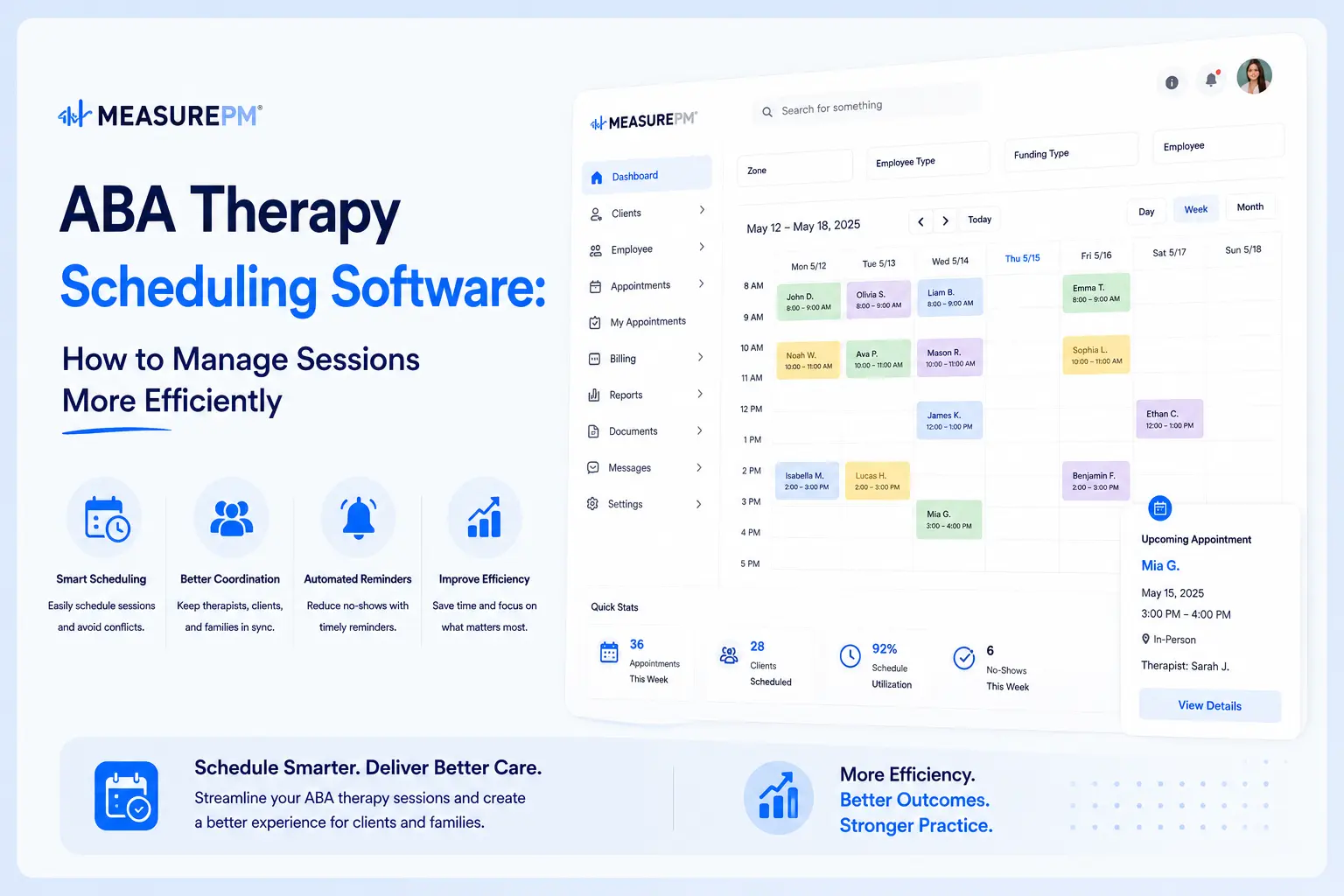
What ABA Therapy Scheduling Software Actually Does
Authorization-Integrated Scheduling
This is the feature that separates ABA-specific scheduling tools from everything else. Authorization data approved service types, unit limits, authorization periods is integrated directly into the scheduling interface.
When a session is being scheduled, the system knows what’s authorized for that client and how many units remain. It prevents sessions from being scheduled beyond authorization limits. It alerts when a client is approaching their unit ceiling with enough lead time to initiate reauthorization before sessions have to stop.
This makes authorization compliance a natural output of the scheduling process rather than a separate manual check that depends on whoever happens to notice the problem first.
Credential Verification
Not every staff member can provide every service. BCBA, BCaBA, and RBT credentials authorize different service types, and payers are specific about which credentials can bill which codes.
When a session is being assigned, the system verifies that the staff member’s credential matches the service type being scheduled. Mismatches get flagged before the session is confirmed not after the claim is denied.
Real-Time Schedule Visibility
When scheduling lives in a shared platform rather than individual spreadsheets or group texts, everyone sees the same current information. RBTs know their assignments. BCBAs know their supervision schedule. Administrators can see gaps and utilization across the full caseload without pulling information from multiple sources.
That shared visibility alone eliminates most of the coordination overhead that consumes administrative time in practices running on disconnected systems.
Supervision Ratio Management
BCBA supervision of RBT-delivered services is both a clinical requirement and a payer requirement. Maintaining appropriate supervision ratios across a full caseload and documenting that supervision adequately requires visibility that manual systems don’t provide.
ABA therapy scheduling software that tracks supervision ratios gives clinical directors a real-time picture of where supervision requirements are being met and where they’re at risk. That visibility enables proactive management rather than reactive correction after a compliance issue surfaces.
Automated Reminders and Attendance Tracking
No-shows and late cancellations are expensive. A session that doesn’t happen is revenue that can’t be recovered and clinical programming that gets disrupted. Automated reminders sent to families before sessions reduce no-show rates in most practices.
Attendance tracking within the scheduling system captures patterns over time which clients cancel frequently, which time slots see the most absences, which staff have attendance patterns worth addressing. That data makes management decisions possible that aren’t possible without it.
Change Management in Real Time
Schedule changes happen constantly in ABA practice. Cancellations, staff callouts, client rescheduling requests, and authorization updates all require schedule adjustments that need to cascade through the system without creating inconsistencies.
ABA therapy scheduling software handles these changes in real time making affected slots available, updating staff assignments, and maintaining authorization compliance throughout. The alternative is a chain of phone calls and manual updates that takes longer, creates more errors, and leaves staff working from different versions of the schedule.
How Scheduling Connects to Clinical and Billing Operations
Scheduling efficiency matters on its own. It matters even more as the starting point for clinical and billing workflows that depend on accurate session information.
Scheduling to Data Collection
When session information flows from scheduling into clinical documentation automatically, staff spend less time on administrative setup and more time on clinical work. The client, targets, session type, and staff assignment are already populated when the session begins not manually entered each time.
ABA data collection software that connects to scheduling eliminates the manual bridge between “session is planned” and “session is documented.” That connection matters for clinical quality real-time data collection during sessions produces better data than retrospective reconstruction and for billing compliance, where session documentation needs to match what was scheduled and delivered.
Scheduling to Billing
Every session that occurs should generate a billable claim. When scheduling and billing are integrated, that connection is automatic. Session data service type, date, duration, staff credential, authorization reference flows into billing without manual transcription.
ABA billing software connected to scheduling doesn’t just make billing faster. It makes it more accurate. The authorization information that scheduling tracks is available to billing without separate verification. The staff credential that scheduling verified is confirmed in the billing record. The errors that come from manual data transfer between disconnected systems don’t happen.
The Full Practice Picture
The real value of connecting scheduling to clinical and billing operations is the visibility it creates across the whole practice. Clinical directors can see schedule utilization, supervision ratios, and authorization status without pulling from multiple sources. Billing has session data without chasing documentation. Clinical teams have current program information without paper-based distribution.
That’s what an integrated platform looks like in practice not a collection of tools that each handle their function in isolation, but a system where information flows where it needs to go automatically.
What to Look for When Evaluating ABA Therapy Scheduling Softwar
Not all ABA scheduling software is equally suited to every practice. A few evaluation factors that matter more than the rest:
Authorization tracking depth. Does the system track units, expiration dates, and utilization rates? Does it alert proactively when limits approach or only flag after they’re exceeded? Prevention is what matters, not just reporting.
Mobile access for field staff. RBTs and BCBAs work in homes, schools, and community settings. A scheduling system that only works well on a desktop serves clinical staff poorly. Evaluate the mobile experience specifically and ask staff to test it in realistic session scenarios before committing.
Offline functionality. ABA sessions happen in locations without reliable internet. Confirm how the platform handles offline scenarios whether staff can access their schedule and session information without connectivity, and how data syncs when connection is restored.
Genuine integration with billing and clinical tools. Ask specifically how session data gets from scheduling into billing whether it flows automatically or requires manual steps that staff have to perform. Integration that requires human bridges isn’t really integration.
Implementation and support quality. A platform that’s difficult to implement or poorly supported after go-live delivers a fraction of its potential value. Ask specifically about onboarding timelines, training resources, and how support requests are handled.
For a concrete look at how these features work together in an actual workflow rather than a feature list scheduling a demo shows you the platform in the context of your practice’s specific needs.
Why MeasurePM for ABA Scheduling
MeasurePM is built specifically for ABA practices not adapted from a general healthcare scheduling tool. More than 10,000 providers across 40+ U.S. states trust the platform to manage scheduling alongside data collection and billing in one HIPAA-compliant system.
The platform operates with 99.99% uptime, meaning scheduling staff can manage their work without system availability being a variable. And because scheduling connects directly to clinical documentation and billing not through exports or manual transfers the efficiency gains extend across the practice, not just within the scheduling function.
Learn why practices choose MeasurePM over generic alternatives and what that choice means for how the practice operates day to day.
FAQs
1. How does ABA therapy scheduling software handle last-minute cancellations?
Purpose-built ABA scheduling platforms manage cancellations in real time. When a session is cancelled, the system updates staff schedules immediately, makes the slot available for other scheduling use, and maintains accurate utilization records. Cancellation tracking over time reveals patterns which clients cancel frequently, which time slots see the most absences giving practices data to inform their cancellation policy and clinical planning. The key difference from manual systems is that changes propagate automatically rather than requiring a chain of communication to update everyone individually.
2. Can ABA scheduling software manage telehealth sessions alongside in-person sessions?
Most purpose-built ABA scheduling platforms handle telehealth as a distinct session type with its own configuration different location requirements, potentially different authorization considerations, and service codes specific to telehealth delivery. When evaluating platforms, confirm specifically how telehealth sessions are handled in both scheduling and billing, since payer requirements for telehealth ABA services vary and the scheduling system should reflect those requirements rather than treating all sessions identically.
3. How does scheduling software support BCBA supervision compliance?
By making supervision requirements visible rather than leaving BCBAs to track them manually. ABA scheduling software that tracks supervision ratios shows clinical directors the full picture of supervision load across the team who’s supervising whom, how frequently, and where requirements are at risk. This visibility enables proactive management rather than reactive correction. For growing practices where supervision capacity can become a constraint on how many clients can be served, this visibility directly informs staffing decisions.
4. What happens when a staff member’s credential expires?
The system flags the expiration before it creates a billing or compliance problem. Provider credentials are maintained in the platform with expiration tracking, and alerts fire when credentials are approaching expiration. Scheduling beyond an expired credential which would create billing denials when the claim goes out is flagged before the session is confirmed. This makes credential management a proactive process rather than a reactive scramble when a claim comes back denied because the rendering provider’s credential had lapsed.
5. How long does it take to transition from manual scheduling to ABA therapy scheduling software?
The timeline depends on practice size and complexity, but most practices reach functional competency with the scheduling platform within a few weeks of implementation. The more important question is what the implementation process looks like whether there’s structured onboarding, data migration support, and training that prepares all staff to use the system effectively from day one. Platforms with strong implementation support get practices operational significantly faster than those that provide access and minimal guidance. Ask specifically about the onboarding process before committing to any platform.
The Practical Reality
ABA therapy scheduling is one of those operational functions that looks manageable until it isn’t. Manual systems work with small caseloads. Spreadsheets work until authorization compliance becomes a billing problem. Group texts work until a staff callout creates a cascade of uncoordinated changes that take hours to resolve.
The practices that invest in purpose-built ABA therapy scheduling software before they’re in operational crisis grow more smoothly than those that wait for visible failure to force a change. The authorization compliance, billing accuracy, staff experience, and clinical quality benefits are available from the first week of use and they compound as the practice grows.
If your current scheduling approach creates more work than it eliminates, that friction has a cost. Purpose-built software exists specifically to eliminate it and to connect scheduling to the clinical and billing workflows that determine how the whole practice performs.
